
Votorola
Votorola was an experimental technology for the public guidance of electoral systems, executive offices, legislatures, and other decision systems. Uniquely it combined the devices of recombinant text, transitive voting, and vote pipes to build a maximum of personal freedom into its facilities. The main facilities were tree-form, decision . Votorola deployed the leafward edges of these in support of the where they provided a purpose and outlet for rational discourse. The opposite trunks it aimed at decision systems that are sensitive to formal consensus. It targeted each of the major types of in society (white) with a special guideway design (green), enabling the hidden complexity of political decision making to be exposed to the scrutiny of rational discourse:
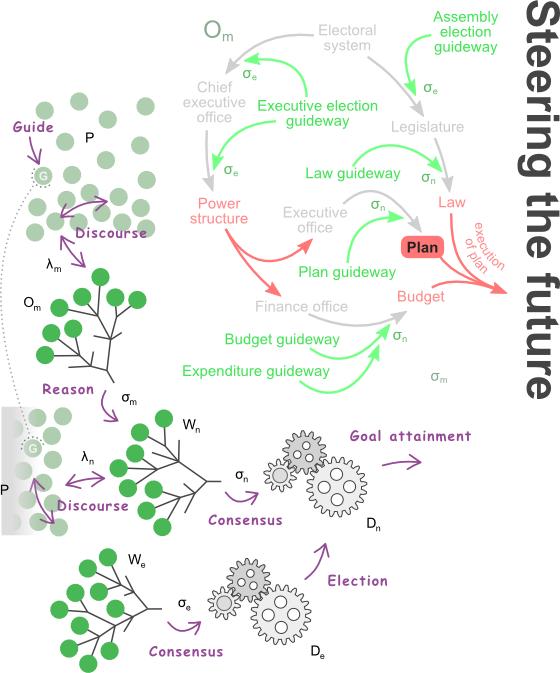
For each decision that is scrutinized, however, the first demand of reason will always be the question, Why? From what cause and to what purpose would we execute this plan? Or enforce this law? When asked with insistence, the question is ultimately mythic, eventually demanding a full-scope explanation of where we come from and where we are going. We would therefore require, above all, a myth-making, or ‘mythopoeic’ (Om) in order to express consensus on the answer. Meantime the technology was based on a provisional answer, a material end for humanity (M0), from which the moral principles of collective orientation (M1) and personal freedom (M2) were already deduced as the formal means:
| Moral theory | Practice | |||
| form | (M2) |
Morality promotes a maximum of personal freedom compatible with equal freedoms for all |
Maximizing personal freedom |
means |
| form | (M1) |
Morality relates personal action to a universally collective end |
Mythopoeic overguidance |
means |
| matter | (M0) |
Morality purposes the endless continuity of rational being |
Forever retelling the myth |
end |

|
||||
|---|---|---|---|---|

| (P1) | Let all communications be limited to light speed. |

|
