The Structuring of Power and the Composition of Norms
by Communicative Assent
A conceptual overview that is not currently maintained. It remains informative, even though
partly outdated by the invention of pipes.
Main Sections:
-
Peer-to-Peer Voting and Communicative Assent
Introduces a medium of communicative assent for the purpose of consensus building.
The backbone of the medium is a peer-to-peer voting mechanism
that is open to continuous recasting (delegate cascade).
It differs from the conventional media of mass assent
in preserving the deliberative basis of consensus, regardless of scale.
-
The Communicative Structuring of Power
Explains how the medium may function as a primary electoral system,
one in which candidates for executive office
are nominated by open, cross-party consensus.
Defines the ultimate election of a consensus candidate
as an instance of communicative action by society as a whole.
Defines assent as a steering medium, alongside money and power,
and describes how it might rationalize the relations between lifeworld and system.
Describes how the structure of assent may serve as scaffolding
for the construction of power.
-
The Communicative Composition of Norms
Explains how the medium may be combined
with a peer-to-peer medium of collaborative drafting (recombinant text),
in order to build consensus on the composition
of societal norms (laws, plans and policies).
Describes how vote flow and text flow are interwoven in the composition,
such that voters and drafters are made equal in its authorship.
Suggests how a consensus norm might be actualized by government.
Provides an example from a legislative context,
in which the unofficial participation of assembly members
opens a “public bridgehead” into the legislature.
-
Conclusion
Appendices:
Peer-to-Peer Voting and Communicative Assent
Communicative assent is the expression of agreement that arises from discussion.
This section introduces a medium in which communicative assent is formalized through voting.
The voting mechanism is a
delegate cascade
that is open to continuous recasting.
In a delegate cascade, a delegate is any participant
who both receives votes (like a candidate), and casts a vote of her own (like a voter).
But when a delegate casts a vote, it carries with it those received.
And so on... Passing from delegate to delegate, the votes flow together and gather in volume
— they cascade — like raindrops down the branches of a tree.1
Every eligible participant has a single vote,
and is therefore a potential voter.
She may either withold her vote or cast it. She may vote for anyone.
There are no pre-declared candidates. All participants are eligible to receive votes.
All non-participants are also eligible.
A non-participant who receives a vote is thereby made a participant, in the role of candidate.
Votes are open to recasting. If a voter changes her mind about a candidate,
she is free to withdraw her vote, or to recast it for another candidate.
Voting is intended to remain open indefinitely, year round,
with the votes shifting as new information becomes available to the participants.
The results are never final.
Votes are public. There are no secret ballots. The identities of all voters are revealed.
Anyone may trace the flow of their votes through the cascade,
and thence to the terminal candidates who hold them.2
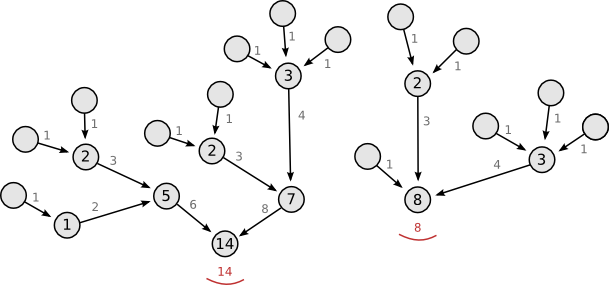
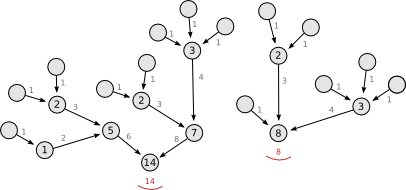
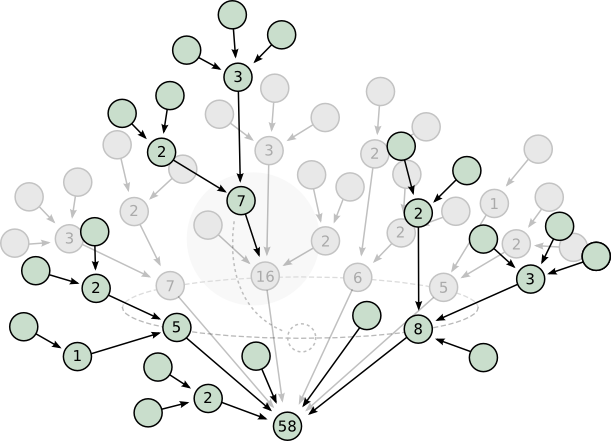
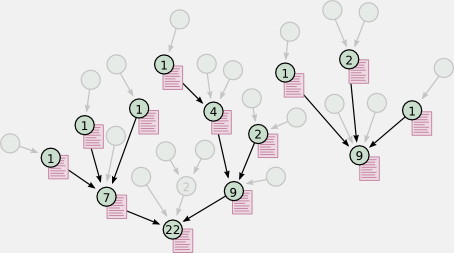
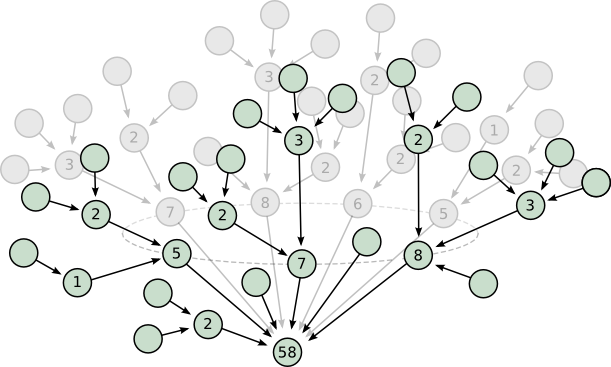
Assent for each candidate is measured by the quantity of votes received
(circled numbers in figures 1 and 2). Note that a single vote may be received by multiple
delegates before it is received by the final candidate.
As each delegate or candidate receives the vote, her measure of assent is incremented.
When the vote reaches the final candidate from whom it can flow no farther,
it is “held” by that candidate.
The total of votes held (red numbers) has, in itself,
no bearing on the measure of assent; only the total received (circled numbers).
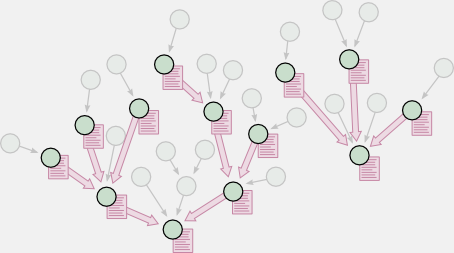
The typical form of a cascade is a tree, as shown in figure 1
(above). Each tree has a root candidate at the base,
voters at the leaves (top), and delegates among the branches in between.
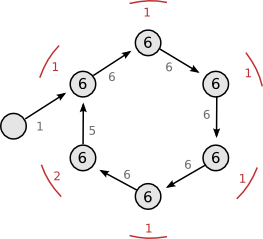
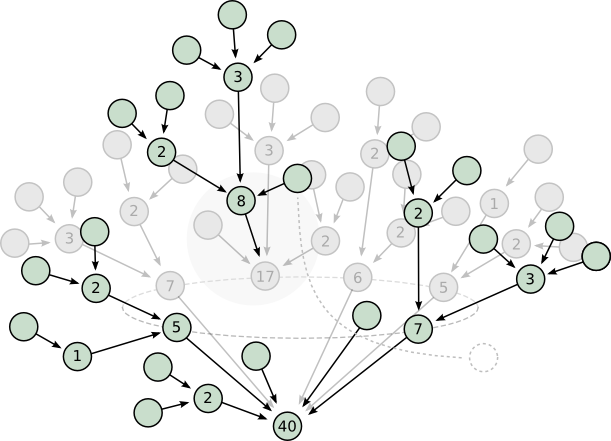
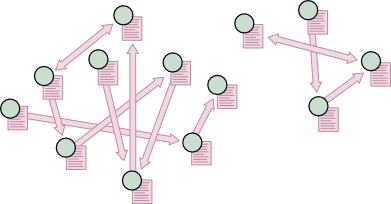
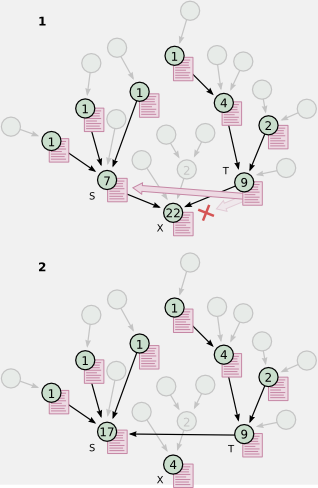
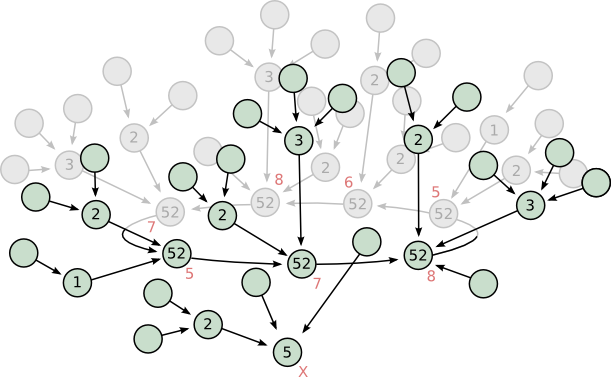
The general form, however, is a cyclic graph. This is shown in the example of figure 2.
This form too might be considered a tree (a very small one in this example),
except that the base is no longer comprised of a single root candidate,
but rather multiple candidates in a cycle.
Such candidates are known as cyclers.
Cyclers are restricted to the base of the "tree",
to which all votes necessarily flow, and are held (red).
Consequently both cyclers and root candidates are
known collectively as base candidates.
Base candidates alone may hold votes.33
A vote never actually cycles. It flows through every candidate exactly once,
but stops before it would re-encounter a candidate for a second time.
It then remains held where it is.
Consequently the level of assent is equal for all candidates in a cycle
(cyclers).
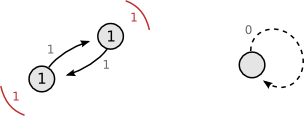
A vote also stops before it encounters its original caster.
Consequently a vote for oneself has no effect.
Assent is the expression of agreement.
Each particular instance of assent is formalized in the medium by the casting of a vote.
The vote is cast for the person who best represents the act agreed to.
(It is always an act.)
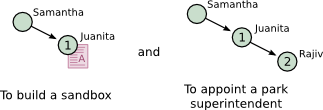
For example, Juanita may propose to build a sandbox for children in the neighbourhood park.
Samantha may agree to this act, and may formally express her agreement by voting for Juanita.
A participant has a single vote for every separately polled act.
If Juanita also proposes that Rajiv be appointed as Park Superintendent,
then Samantha could vote for Juanita on that act, too.
The two votes — one to build the sandbox, and one to appoint the superintendant —
would have no formal connection to each other.
They would be cast in separate polls.
A poll is a collection of votes for measuring consensus or dissensus among voters.
Variant acts may be proposed. Variant acts are alternatives to the originally proposed act,
and not separately polled acts. When a variant act is proposed,
the participant does not gain another vote to cast.
Instead she gains a choice of which act to vote for.
She may choose either the originally proposed act, or the variant, or neither (abstaining).
Thus Monika may hear of Juanita's plan, and join Samantha in voting for it (plan A).
She might suggest, at the same time, that the sandbox
ought to be larger than Juanita is proposing (plan B).
Samantha might shift her vote to Monika as a sign of approval for plan B,
or she might keep it with Juanita. She would have a choice.
The objects of the choice (original and variant acts)
are called candidates.

A candidate always has two aspects: an active aspect, and a personal aspect.
The active aspect is the proposed act.
The personal aspect is the person who proposes, or represents, or embodies the act.
Thus the building of the larger sandbox (act) and Monika (person)
are one and the same candidate. We can speak of voting for a larger sandbox,
or of voting for Monika, but the two have the same meaning.
The personal aspect of a candidate is formalized in the medium by a personal identifier,
so one always knows who the candidate is for any vote that was cast.
But the active aspect is only formalized optionally, by a link.
Thus Monika may have a web page that details the dimensions of her enlarged sandbox.
She may formally link her candidacy to that page in order that people may discover
what she is proposing, without personally asking her. But this is optional.
The separate candidates need not be mutually exclusive.
We know that delegation may enable a single vote to be received by multiple candidates,
thereby expressing agreement to multiple, simultaneous acts.
We expect those acts to be, in some sense, logically compatible with each other.
Thus by continuing to vote for Juanita, even while proposing a somewhat different plan,
Monika might be hoping that Juanita will eventually agree to amend her own plan.
Then, if Samantha were to shift her vote to Monika,
she might be aiming to further that amendment.
So, with a single vote, Samantha could express her assent for both candidates,
and her desire of seeing them work together.
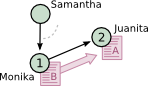
Assent may build as new participants join in the voting. The votes are public,
so each newcomer can discover who is involved, and what they have agreed to.
The newcomer may join in the ongoing discussion between a candidate and her voters,
and may cast a vote of her own.
She may propose new candidates and invite other participants to join. And so on.
A consensus that originally formed among 2 or 3 people might therefore grow a little larger.
In principle, there might be no limit to its size. Before going farther, however,
it is important to consider how this differs from conventional voting.
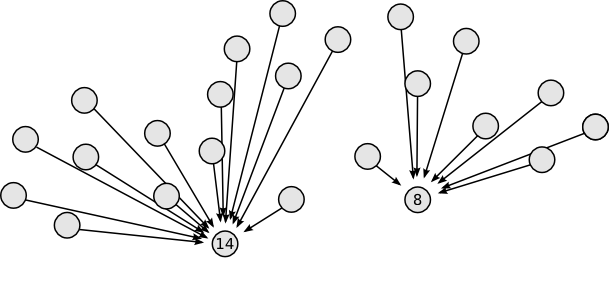
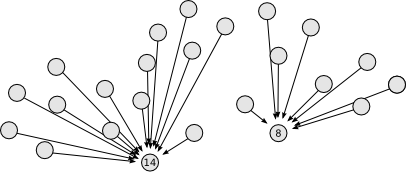
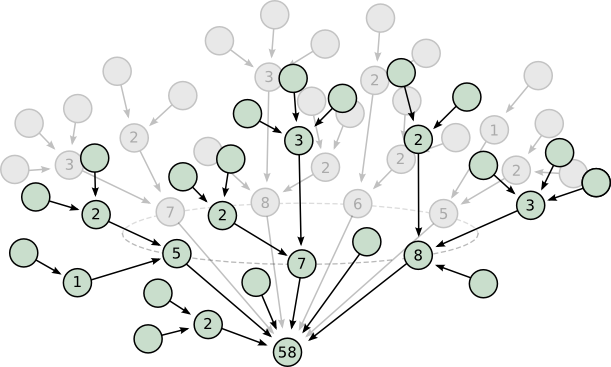
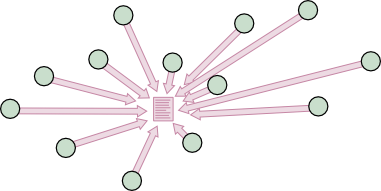
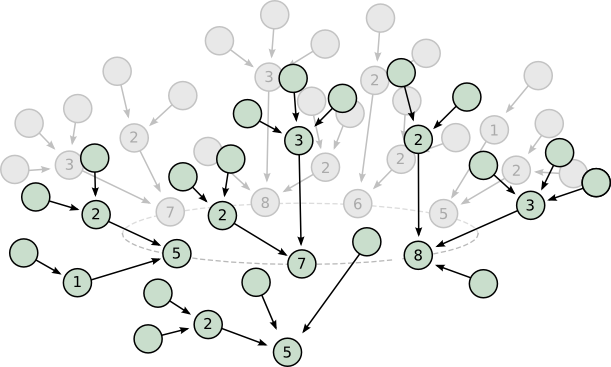
Figure 4 illustrates the case in which the voters avoid delegation
and cast directly for root candidates. Instead of a tree,
the result is an imploded star pattern typical of mass voting media.
There are many voters, no delegates and only a few candidates.
Mass voting imposes a limit not to the scale of assent itself, but to the scale of discussion.
Because the number of candidates is restricted and the number of voters is not,
there is a point at which discussion between voters and candidates is no longer possible.
That point is the boundary between communicative assent and mass assent.
As the scale of mass assent increases, newcomers will find it increasingly difficult
to discover exactly what act is being agreed to.
Beyond the few voters who remain in touch with the candidates,
everyone else will be in the dark.
Their participation as voters will not have enlightened them.
They will not be able to ask what is at stake,
because if the candidates were to intercommunicate with the voters
they would be flooded with questions.
The only source of information will be other forms of mass media,
all of which are inherently one-way channels.
With no discussion between the voters and the candidates,
the assent of the voters cannot be characterized as communicative.
It cannot have arisen from discussion.3
By contrast, if assent is being mediated by a delegate cascade,
the newcomer finds it easier to join the process.
She can discover what is at stake by asking any of the voters or delegates
in the outer branches of the cascade. She can go shopping among the delegates,
using her vote as leverage to enter discussions, and maybe to gain concessions.
She can make suggestions. She can even solicit votes herself
and thus increase her leverage, and her ability to move deeper in the cascade.
It does not matter to her if a dozen participants are involved,
or a neighbourhood, or a whole city. The discussion is no less lively for all its extent,
and no less inviting to newcomers.
The following sections will explore how such a discussion may lead to concrete results
— how the communicative assent of the participants
may be realized as communicative action by the whole of society.
For example, consider this simple scenario:
Scenario 1.
A group of young people wish to make improvements to their neighbourhood park.
They come up with a plan and begin to promote it locally.
Some of them are in disagreement and propose alternative plans.
They all share access to a medium of communicative assent.
They use it to highlight their differences and to resolve them one by one.
Eventually the whole neighbourhood agrees on a consensus plan.
The City sends a safety inspector to the site, and trucks in some sand.
With a little help, the young people complete the improvements to the park.12
The improvements might be as simple as adding a new sandbox for children,
or as complex as renovating the athletic facilities.
The number of participants might be a hundred for a small neighbourhood,
or ten thousand for a large one.
In any case, once they had reached a rough consensus, government would be prompted to act.
The reasons why are hidden in the underlying details of the scenario.
Before looking at them, it will help to consider how communicative assent
may express itself in mass elections.
The Communicative Structuring of Power
This section explains how large scale assent in the public sphere may be actualized,
such that society as a whole becomes engaged in communicative action.
In other words, after people agree to something, it actually gets done.
This depends on the interrelations between communicative assent and administrative power,
particularly with regard to the election of executive officers
and the delegation of their powers.
Adminstrative power in modern democracies is controlled by electoral systems.
Adding a new voting medium to the public sphere cannot change
the structure of these electoral systems, but it can change who is elected through them.
Ordinarilly a candidate of an organized political party is elected.
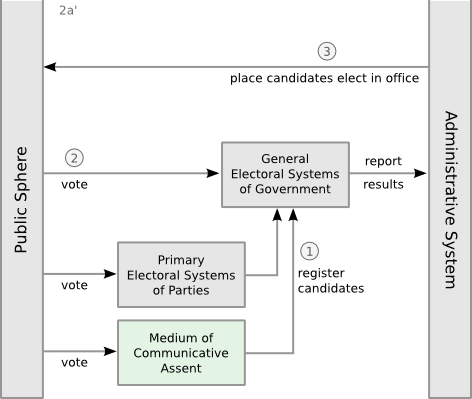
The path to election is shown in figure 5.
The candidate is first chosen by the party members in a primary election (1),
then wins mass assent in a general election (2), and finally enters office (3).
This same election path would be open to candidates from the medium of communicative assent.
The medium may therefore serve as a primary electoral system,
much like the primary electoral systems of the parties.
The medium is not, however, a political party. It has no leader, no staff and no members.
It has no proper name, serves no particular interests,
and has no status as “registered party”.
Nevertheless it may serve many of the same functions as a party.
A voter who did not wish to support any of the endorsed party candidates
might use the medium to nominate her own candidate. She could do this simply by casting a vote.
Other participants might join her by casting their own votes,
and some of them might nominate additional candidates of their own.
If the medium was used in this way,
then it would come to occupy the same political “niche” as the parties,
without itself being a party.
It would therefore be competitive with the party system as a whole.
To be truly competitive, however, it must meet two requirements:
1) sufficient voter turnout in the medium;
and 2) faithful carriage of votes from the medium to the general polls.
First of all, the primary turnout must be high enough to indicate that at least one candidate
has substantial electoral support.
The turnout need not match the level of general turnout on election day,
but it ought to be high enough for each candidate to extrapolate the results,
and gauge her level of support in the general electorate.
Otherwise they might not bother to register for the general election (step 1 in figure 5).
The second requirement is that the voters must faithfully carry their votes
over to the general polls on election day (step 2).
They would have to translate assent from a communicative medium to a mass medium.
Figure 6 shows what is involved in the translation
with respect to a single winner, plurality election.13
Each voter recalls the name of the candidate who currently holds her vote in the cascade
(a name she knows well enough, or her delegate reminds her),
and casts a vote for that same candidate at the general polling station.
If these requirements are met, then it is possible for a candidate from the medium of assent
to win an election and enter office.
Furthermore, if the turnout in the medium were ever to approach or exceed
the turnout at the general polls, then the process would likely be irreversible.
Communicative elections would become an institution of the public sphere,
and mass elections would become something of a formality,
each the recapitulation of a more complex and deeply rooted opinion that was previously formed.
This much is assumed in the underlying details of the park improvement scenario:
Scenario detail 1.1.
Mae is a community leader in the neighbourhood, and the local delegate for the Mayor.
When she learns of the plans to improve the park she takes an interest.
Mae speaks to Hal. Hal is the local delegate for the Public Health Officer.
Mae asks Hal to look into the safety issues of the proposed plan.
Hal agrees. He takes the lead in drafting a set of safety amendments.
His amendments attract the votes of many parents in the neighbourhood.
The votes are numerous enough to ensure that safety concerns
are going to feature prominently in the plan.
The young planners have a question about the delivery of the sand, so they approach Wen.
Wen is a local building contractor, and a delegate for the Public Works Office.
He explains that several types of sand are available from the City yards.
He says that delivery, however, will depend on budgetary approval.
So they add “sand” to the budget section of their plan.
Later, when it appears that a consensus is likely to form at some point,
Mae requests approval for the plan.
She does not speak directly to City Hall, rather she speaks to her delegate
— the person she is voting for in the Mayoral election.
In reply she receives a signed email from the Comptroller of the Parks Department,
authorizing a preliminary safety inspection of the site.
Mae then forwards the authorization to Hal, who arranges for the actual inspection.
When the safety inspector arrives, Hal guides her to the site...
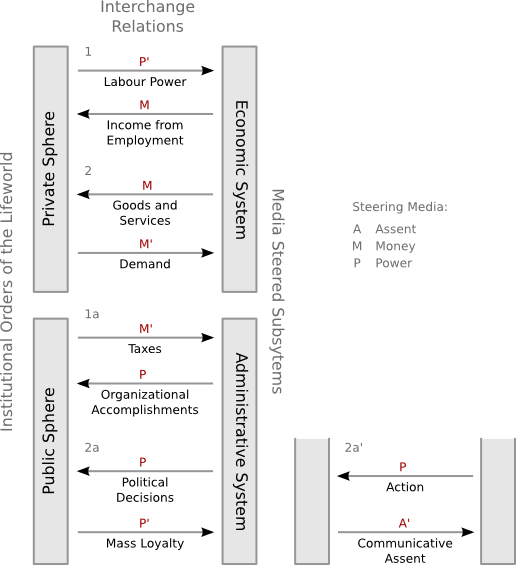
In terms of critical theory, the medium of assent is rooted
in the communicative half of society known as the “lifeworld”.
It transforms the citizenship interchange relation that exists
between the lifeworld and the other half of society,
known as the “system” (figure 7).
Instead of receiving what Habermas characterizes as “mass loyalty”
from the lifeworld, the system receives communicative assent;
instead of responding with an issue of political decisions, it responds with an issue of action.
Normative guidance is thus transferred to the lifeworld
and society as a whole is engaged in communicative action.15
Communicative action
is action that is coordinated by discussion aimed at mutual understanding or agreement.4
Its application to the structure of power is the topic for the remainder of this section.
The subsequent section (3)
will address the composition of norms, such as laws, plans and policies.
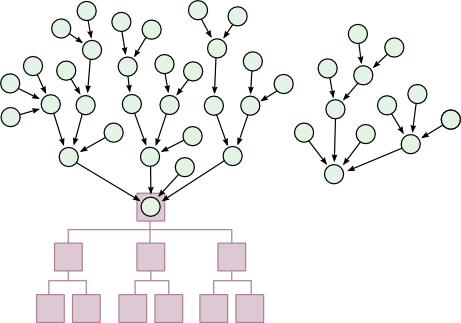
With regard to power, a candidate for executive office
may win election through communicative assent (figure 5).
She would then be placed at the root of a power structure, as shown in figure 8.
In the case of a mass election, it ordinarilly stops there.
But a communicative election may extend its effects deeper into the power structure
by influencing the selection of subordinate officers.
The rationale for the selection of subordinates will vary,
but the main qualifications are perhaps competence, compatability and patronage.
All three may be found in abundance among the principal delegates who voted for the executive.
In each case, the measure of qualification is the number of votes carried by the delegate.
Votes are the measure of competence because they qualify
the delegate as a second tier winner — a runner-up in the election —
and therefore qualified for the second tier of offices.
Votes are the measure of compatability because their acquisition
depends on the delegates working together for the successful election of the candidate.
Finally, votes are the measure of patronage,
because it is only by the assent of the delegates and their voters that the candidate
is brought to office; and the rule of patronage is,
“you dance with them that brought you”.
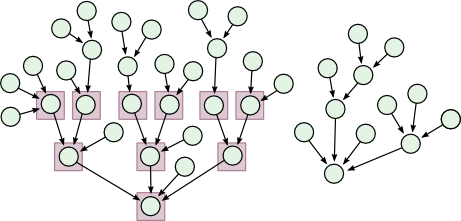
The major voters of an executive candidate are therefore attractive, in their own right,
as candidates for subordinate offices. Any major voter thus appointed
is placed at the commanding node of a power sub-structure,
which she may further extend by her own appointments.
Again, she may look to her own voters for guidance. And so on. The process is recursive.
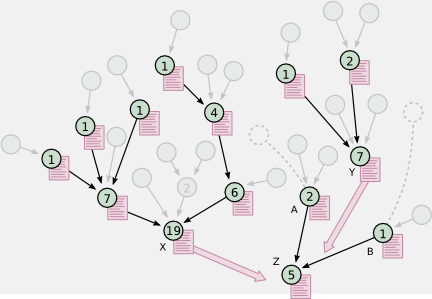
Assent may therefore serve as scaffolding for the construction of power,
delegate by delegate, as depicted in figure 9.
Once a power structure is assembled, however, the roles are likely to be reversed.
Then it is the structure of power that guides, and assent that follows.
Consider the case of local leadership in scenario 1.1.
The local leader (Mae) holds neither office nor direct power,
but she does have a measure of influence as a minor delegate in the mayoral election.
She demonstrates this when she champions the park improvement plan and mediates its approval.
The reason for her success stems partly from the votes she carries.
If her request for official approval had been ignored or rejected off hand,
she would probably have spoken to her delegate. At stake for the delegate
would be Mae's vote and the several hundred others she is carrying from her neighbours.
If the delegate were unhelpful, then Mae could look elsewhere in the power structure,
shifting her vote until she found a more effective channel of influence.
However, she could not shift her vote with complete freedom.
Her own electoral support is based on influence,
and to retain it she must continue to direct her vote
rootward into the power structure (figure 9, left).
As a general rule, votes of assent are constrained to flow
within the channels that define the existing structure of power.
To decide the issue of a new power structure,
the constraints of the old one must be lifted,
and assent must be freed to resume its guiding role.16
This would automatically occur as the end of the term approached
and voters' thoughts inclined to the pending electoral decision.
Their votes would begin to shift more freely,
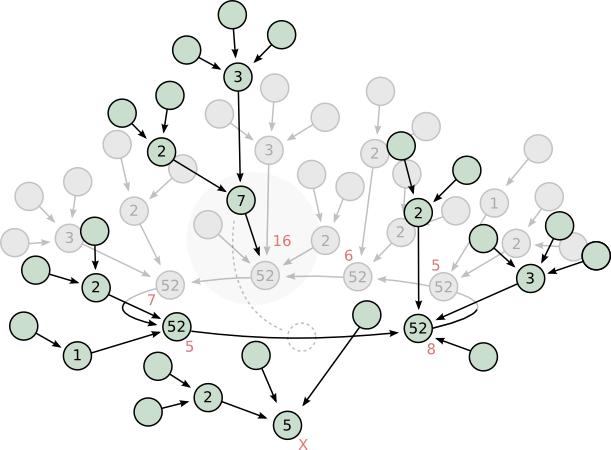
as illustrated in the following sequence of diagrams:
The Communicative Composition of Norms
This section explains how communicative assent may be combined
with collaborative drafting in order to build consensus on the composition
of societal norms (laws, plans and policies).
It then suggests how such a consensus might be actualized by government,
with an example from a legislative context.
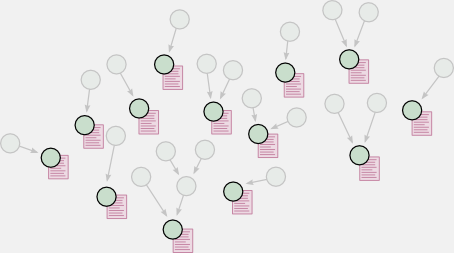
Ordinarilly, we might expect a collaborative effort that is focused on a single document,
to which multiple drafters push their contributions (see figure 13).
Such a centralized pattern of communication
is reminescent of mass assent.
Participants are constrained to a small number of choices (one in this case),
and have no formal outlet through which to express dissent,
except perhaps by withdrawing from the process.
On exposure to communicative assent, this centralized pattern
is necessarily broken apart and dissolved. Voters enter the picture, as we may imagine.
They begin individually to express their agreement with the ideas of particular drafters,
and to shift their assent freely from one to another.
The drafters are thus encouraged, in turn, to express their ideas more clearly.
Each takes to composing a separate document that embodies her own peculiar conception
of what the norm should be. The text therefore diverges into multiple variants
that co-exist side by side, as shown in figure 14.
Despite their differences on some issues, the drafters will often be in agreement on others,
and will collaborate by sharing useful bits of text amongst themselves.
Their lines of communication might trace a criss-cross pattern,
with no overall direction, as shown in figure 15.
Because this form of collaboration depends on a ‘population’ of variants,
and the cross-transfer of textual snippets,
it is called a ‘recombinant text’.9
With communicative assent, however, a drafter is not only eligible to receive votes
(as a candidate), she may also cast a vote of her own
and thus share her votes (as a delegate) with other drafters.
Naturally, she will use these shareable votes as leverage
in order to disseminate her ideas as widely as possible in the population of variant drafts.
The candidate who receives her delegated votes will also be expected to receive her ideas,
in the form of textual contributions.
But the flow of such delegated votes must cascade. Consequently, a few of the drafts
will come to accumulate a preponderance of assent, thus expressing a tentative consensus.
All of the participants will be striving to maximize their influence
on the flow of text toward these consensus drafts;
while, at the same time, the consensus drafters will be striving
to attract and retain their votes.
So the contributory text that is drawn from the ‘cloud’ of documents
will tend to flow along lines of assent, and deposit itself in a pattern that closely matches
the consensus (and dissensus) of the participants.14
The structure of assent is likely to fluctuate considerably during the composition of a norm.
Unlike in executive elections, it will not become attached to a power structure.
Its only attachment will be to the evolving content of the text.
Consequently, the voters will be shifting their assent here and there
in attempts to influence the course of the composition.
Meanwhile, the drafters will be shaping the text and shunting its flow
in order to attract their votes. The resulting interplay is likely to have a complex dynamic,
which might be understood, in part, on the basis of numerous contributory patterns.
Figures 17 and 18 predict two such patterns (bridging and shorting consensus).
Two social processes that would otherwise be separate
— the building of public consensus among voters,
and the composition of a law, plan or policy among drafters —
are thus interwoven in the communicative medium.
The combined process might be characterized as shifts of assent
(actual and anticipated) steering the evolution of the text,
pushing and pulling it into shape.
So detailed and extensive is their expected interweave,
that it will be impossible to disentangle the roles of the voters and the drafters;
all will be equally authors of the norm.
If they were, in addition, numerous enough to prompt action by government
(enforcing the law, executing the plan, or following the policy),
then the combination of their individual actions would amount to communicative action by society
as a whole (figure 7).
For example, consider a legislative process.
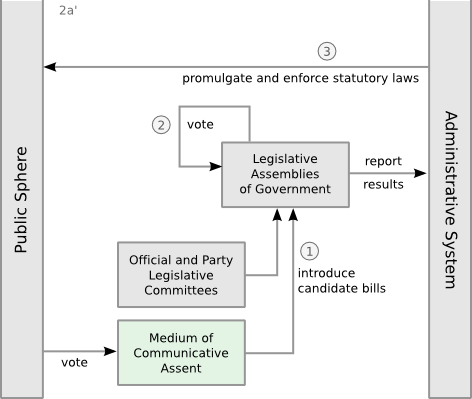
The medium of assent might serve as an input to the legislature,
feeding in bills from the public (figure 19).
It would thus function as an alternative to closed-door committees.
Such a change in legislative relations might be furthered by a parallel change in
electoral relations (figure 5). While the public was openly
voting on bills to put before the assembly, it would also be openly voting on the
seats of the assembly members. Even without this added influence, any proposed bill
that had managed to acquire an extensive consensus in public would attract the
attention of most law makers, and the active support of at least some. The easiest
way for them to express their support would be to participate by casting open votes of
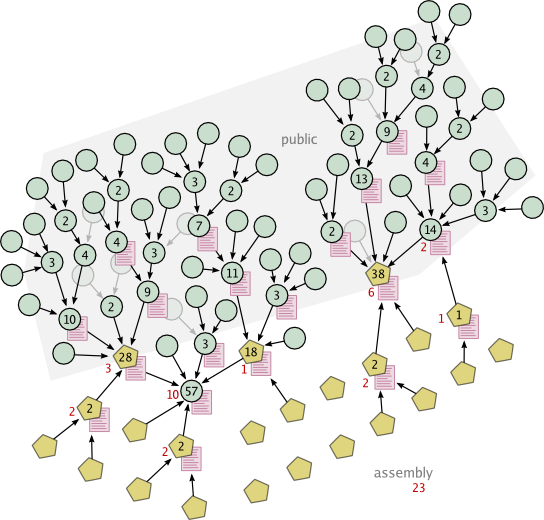
their own. Although unofficial, their votes would nevertheless provide a nucleus of
support for an eventual vote within the assembly, while the combined tally would
provide a forecast of its likely success. This possiblility is illustrated in figure
20:
Before the bill could be floored,
the assembly would require an official version of the text.
This might be obtained by freezing the consensus draft for a period of time.
No modifications would be permitted during this time,
but the voters would remain free to shift their votes. If the consensus nevertheless held,
then the assembly could proceed to ratify the bill.
It would then become law. In this way, law making might be opened to the public
without requiring any structural changes to government.
The changes would be entirely in the public sphere.
Conclusion
I have described how a restructuring of power and norms on communicative lines may
effect a transfer of normative guidance from administrative systems to the public
sphere. The feasibility of this transfer depends entirely on constitutional
guarantees of periodic elections in which power is restructured. The ability of
electors to control the restructuring of power is enhanced by a transfer of primary
electoral decisions from party organizations to the public, where they are instead
expressed as public opinion. There are two modes of expression here:30
- Normative opinion - what ought to be
- Authoritative decision - what is to be
In an electoral context, normative opinion is formed in electoral primaries. People
(as a public) roughly agree on who is fit to hold office. Authoritative decisions are
then made by the same people (now as private individuals) in official, secret-ballot
elections. There the electoral power of the elector shapes the administrative power
of the newly elect, who (as officers) now gain the exclusive right to issue further
authoritative decisions.
Meanwhile, the public retains the right of normative guidance. Their capacity to
guide the administrative power of elected officers is enhanced by their ability to
reach large-scale consensus on the laws, plans and policies that ought to be executed.
Thus the normative and authoritative — the recognition of what ought to be done,
and the doing of it — are kept separate; the normative going to the
communicatively-structured public sphere, and the authoritative to the
power-structured administrative system.
Argument of Direct Democracy
(c) RD + FS + IT > DD
This section recapitulates the political argument of the theory in semiformal terms.
The political argument (c) is that the institution of a medium of communicative assent
will transform a traditional representative democracy into a substansive direct democracy.17
| Symbol |
Meaning |
| + |
Union operation. Thus “X + Y”
means “both X and Y in combination”. |
| > |
Causal operation.
Thus “X > Y” means “X causes Y”.18
|
| A |
Administrative action, either of: |
| A(n) |
- |
enforcement of a norm; or |
| A(o) |
- |
emplacement of an official. |
| DD |
Direct democracy. |
| FS |
Freedom of speech. |
| M |
Medium of communicative assent, instituted such that it:
|
| M(a) |
- |
authenticates voters as real people (no robots); |
| M(c) |
- |
affords a consensus that neither suppresses dissent,
nor is unnecessarily fragmented by it;
|
| M(p) |
- |
allows voters to openly propose the issue and options,
not just to vote on them;
|
| M(r) |
- |
restricts votes to local residents,
or others who are immediately affected by the issue; and
|
| M(s) |
- |
enforces a single vote per person (no sock puppets). |
| OP |
Public opinion, either of: |
| OP(i) |
- |
informal public communication; or |
| OP(f) |
- |
formal public vote. |
| OR |
Private opinion, either of: |
| OR(i) |
- |
informal private belief or communication; or |
| OR(f) |
- |
formal private vote. |
| PD |
Public decision, on either of: |
| PD(n) |
- |
enforcement of a norm; or |
| PD(o) |
- |
emplacement of an official. |
| RD |
Representative democracy. |
FS is a constitutional fact. FS allows for OP(i), and OP(i) is an everyday fact:
(a.1) FS > OP(i)
But M is technically feasible.19
People are therefore likely to use it to formalize OP(i) as votes:
(a.2) OP(i) + M > OP(f)
But the resulting OP(f) is generally visible. Other people can see
it, and are prompted to form private opinions of their own - OR(i) -
either in assent or dissent of the issue. Furthermore, some of these
opinions will be published and formalized as votes. So OR(i) and
OP(f) will be locked in a positive feedback loop:
(a.3) OP(f) > OR(i) > OP(f)
But M(c) ensures that any OP(f) dissensus that is not grounded in
social reality will be unstable. It will therefore fall toward
consensus. So we can expect consensus. Any consensus that attracts a
quorum of voters (however defined), and that holds stable, is PD by
definition.
(a.4) OP(f) + M(c) > OP(f,consensus) = PD
On the one hand, the medium M may be configured to support primary
elections, and thus to to nominate cross-party candidates for office:
(a.5) OP(f) + M(c) > PD(o)
On the other hand, M(p) allows for issues to be raised without
restriction. So PD may focus on norms (laws, plans and policies) too:
(a.6) OP(f) + M(c,p) > PD(n)
To summarize (a.1) to (a.6), the institution of a medium of assent
will result in the formation of public decisions:
(a) FS + M > PD
RD is a constitutional fact. OR(i) is a psychological fact. At the
regular occurence of general elections, OR(i) is formally expressed in
secret voting. The administration then acts to place the winning
candidates in office. This process is a fact:
(b.1) RD + OR(i) > OR(f) > A(o)
But note the alignment of OR(i) and OP(f) in eqn (a.3). Furthermore,
from (a.3), allow a rough parity between the levels of primary and
general turnout. It then follows from (a.5) that OR(i) is generally
aligned with PD(o). So (b.1) reduces to:
(b.2) RD + PD(o) > OR(f) > A(o)
In other words, the general elections of RD will actualize the primary
elections of PD(o). Thus officials will be emplaced - A(o) - by
public decision.
Now consider norms. First, consider the situation when PD(n) is
framed as a legislative bill. It will then be of interest to a member
of the RD legislature. The member will be particularly interested in
the level of support for the bill among her own constituents, as
revealed by M(a,r,s). Considering that her re-election bid will
depend (b.2) on her successful performance in the ongoing primary
elections, she will align her assembly vote with the particular PD(n)
of her constituents. The same consideration applies to the other
members. The upshot is that the legislature will promulgate the
general PD(n) as a statutory law:
(b.3) RD + PD(n) + A(o) > A(n)
Likewise for the other types of norm (n). So, when PD(n = policy) is
expressed, the elected executives will act to follow that policy.
When PD(n = plan) is expressed, they will act to implement that plan.
From (b.1) to (b.3), it follows that both the placement of officials
and the enforcement of societal norms will be aligned with public
decisions:
(b.4) PD + RD > A(o) + A(n)
But PD is a decision of the people. By definition, when A(o) and A(n)
are aligned with PD, society functions as DD. So (b.4) reduces to:
(b) PD + RD > DD
From (a) and (b):
(c) RD + FS + M > DD
Given that RD and FS are constitutional facts,
the immediate cause of the direct democracy DD is the introduction of the medium of assent M.
Participation and Consensus in a Work of Utopian Literature
(rough)
Since the close of the eighteenth century,
the discourse of modernity has had a single theme under ever new titles:
the weakening of the forces of social bonding, privatization and diremption
— in short, the deformations of a one-sidedly rationalized everyday praxis
which evoke the need for something equivalent to the unifying power of religion.
— Habermas PDM.139
The rationality of consensual norms is radically dependent
upon the rationality of a history at risk.
The rationality of human social existence is always the rationality
of possibilities that hold the promise of the fulfillment of the good.
— Garth Gillan 26
This section asks the question:
What if a medium of communicative assent were applied to the composition of utopian literature?
The idea of using a recombinant text to open utopian works
to public participation was already briefly suggested.22
This section raises the possibility of introducing formal assent to that medium,
such that participants are able to guide the composition by their votes,
and to reach consensus on the issue.
Howard Segal looks into the reflective and steering capacities
of ‘serious utopian visions’.
According to Segal, a serious utopian vision is a kind of reflection of larger society.
It functions best not as a literal blueprint for the future,
but as a critical representation of the present,
and as a possible motivation or guide for change.23
But the introduction of assent might have the effect of firming up these functions,
making the representation more literal, and the guidance more compelling.
At one point in his lecture series The Philosophical Discourse of Modernity,
Habermas seeks an explanation for society's inability to steer itself.
Part of his intent is to explain its past and present failure to do so,
but he also raises the possibility of future structural changes.
However, these are changes that would “sensitize” a directionless society
by wiring it up in order to avoid the worst crises and dystopias,
and not changes that would give it a positive sense of direction.PDM.357-364
Considerations:
- Not only literary, but other forms of utopian expression
- The capacity to bind all three rationalization complexes
- The connection between reason and rationalization in this context
- A “stable center of self reflection” for society
- The effects of acheiving a utopian consensus
- The effects of attempting it
- Gadamer's hermeneutics and a future-directed “fusion of horizons”
- Many pasts, many futures, one present consensus
(a) Consider that “literature” is intended to include other forms
of expression that are suitable for utopian visions, such as theatre or film, and so forth.
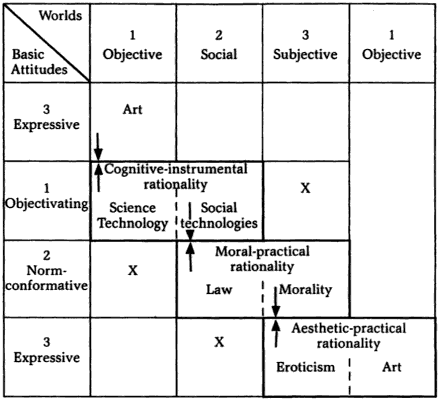
(b) With reference to figure 21,
consider how utopian literature may be different from other cultural fields.
Consider it from several perspectives:
inter-subjectively engaging in its collaborative composition;
subjectively reading it in private;
and objectively considering its end effects within the various worlds.
Utopian literature seems to have a unique potential to bind together
the separated worlds, attitudes, and rationalization complexes that make up modern society.
Furthermore, in order to gain consensus, a given work of utopia would have to be receptive
to the entire constellation of fragmented and specialized fields of culture,
and it would have to speak to all of them, without especially favouring any one in particular.
In this it would be different from a merely political consensus,
such as formally expressed in a law, plan or policy,
which is always more-or-less focused and technical.
Assuming that a utopian consensus is possible
— that in principle we could all agree on a single vision of the future —
is there anything else that might have a comparable binding capacity?
(Should the scope of research be expanded?)
(c) What is the connection between reason and rationalization in this context —
between the tripartite bindings of formal pragmatics,
and the tripartite bindings of utopian literature —
between communicative action and mutual understanding in the small,
and utopian works and visions in the large?
(We might look at how the binding capacity of morality, to which
“[s]omething of the penetrating power of primordial sacred powers still attaches”,
figures into it.TCA2.92)
Gillan refers to HabermasTCA1.249
in stating that “the unity of rationality is procedural and not substansive”.26
One does not inspect the content of the message,
but rather the process of its construction and conveyance.
So we might look into whether the binding capacity of a utopian consensus
is not likewise procedural as opposed to substansive.
In there any connection here with the procedure of cascade voting,
and the fragmented contents of a recombinant text?
A recombinant text is certainly a text of rationalized content,
one that can spread itself out to match the rational structure of the differentiated lifeworlds.
So an artist's copy of the text need not be the same as a scientist's or a politician's,
and all are free to work independently or in collaborations of their own choosing.
At the same time, cascade voting is certainly a unifying procedure.
Like discourse in an ideal speech situation,
it shapes the text toward consensus without ever forcing it.
For those acting in the first person singular or plural
with an orientation to mutual understanding,
each lifeworld constitutes a totality of meaning relations and referential connections
with a zero point in the coordinate system
shaped by historical time, social space, and semantic field.
Moreover, the different lifeworlds that collide with one another
do not stand next to each other without any mutual understanding.
As totalities, they follow the pull of their claims to universality
and work out their differences until their horizons of understanding “fuse”
with one another, as Gadamer puts it. Consequently, even modern, largely decentred societies
maintain in their everyday communicative action a virtual center of self-understanding,
from which even functionally specified systems of action remain within intuitive reach,
as long as they do not outgrow the horizon of the lifeworld.
This center is, of course, a projection, but it is an effective one.
The polycentric projections of the totality
— which anticipate, outdo, and incorporate one another — generate competing centers.
Even collective identities dance back and forth in the flux of interpretations,
and are actually more suited to the image of a fragile network
than to that of a stable center of self reflection.PDM.359
(d) Assume these competing centers, as Habermas describes.
Assume also that one of them is a utopian vision
on which a broad and deliberate consensus has formed.
Would it thereby rise above the others to become the actual center of reflection?
From what quarter might this rise be challenged? On what grounds?
And finally, is there (or ought there to be) an executive center in society
that could complement a reflective center?
(e) Furthermore, consider that a consensus on a utopian vision
would imply the acceptance of its rationality in all three modes (figure 21).
So people would generally think that its content
was true in a scientific sense, and feasible in a technical and social sense;
they would generally agree that its intention was just and morally right;
and they would generally perceive that its expression was aesthetically beautiful.
What personal, social and societal effects could be expected to follow from this?
(f) Consider the time prior to a consensus, when multiple utopian visions are competing
and there is no guarantee of them ever coming together or being bridged.
What personal, social and societal effects could follow from the ongoing attempt?
Or from the ongoing failure?
(g) In Gadamer's theory of hermeneutics,
the practice of “application” is crucial.
The interpreted historical text is applied to the present,
which results in a “fusion of horizons” between the past and the present,
and the emergence of understanding. Understanding is here the product.25
What is the equivalent theory for a valid text that is not historic but utopian.
The text is validated not by a tradition that was formed in the past, in this case,
but by a consensus that is formed in the present.
Embedded in that consensus is a pre-given mutual understanding.
Can this mutual understanding be taken as the equivalent of hermeneutic understanding?
It would then be a variable on the input side, and not a product.
If moreover the application of the utopian text can be said to
result in a fusion of horizons between the present and the future,
then what would be the product of that fusion? Would it be the future itself?
In that case, the turn toward that direction would also be a turn from
the epistemic to the ontogenetic, from an orientation of understanding to one of creation.
(h) These textual lenses (g) seem to reveal many pasts and one future.
Multiple traditions validate multiple texts for interpretation,
in each of which we perceive a more-or-less different past.
Meanwhile, the future is revealed (if at all) in a single view,
because the only mode of validation in this direction is consensus. This is counter-intuitive.
We expect a single past (that actually was) and multiple futures (that yet might be).
The single future is not a social limitation of consensus, however,
but a physical limitation of worlds. We think in terms of one shared world.
But if the vision of the future can reach far enough in space and time,
then it becomes possible to accomodate multiple physical worlds. If it can reach farther still,
such that the space/time between contemporaneous worlds
is socially unspannable (as in light years)
then those worlds will be independent of each other.
In the context of utopian literature, we are somewhat free to suspend doubt
and consider what might follow from accepting this dispersed setting.
First, it would accomodate an unlimited number and variety of futures
with no possibility of substantial dissensus at distance.
Any nascent dissensus that threatened the future could easily
be resolved by the creation of a separate world,
thus moving the dissensus from the structure of assent to the structure of the text,
where the worlds are free to pursue their separate futures without interference.
Consensus building efforts might then hinge more on the nearer view
prior to achievement of the necessary distance.
(Even this view is beyond the range of political plans and policies,
which are all relatively short term, and are voted as separate polls.)
The second consequence of such a dispersed setting is that it holds the promise of safety.
Remoteness is the guardian not only of diversity, but also of existence.
Any realistic vision of the future is likely to be haunted by the possibility
of mutual destruction, but that possibility is ultimately precluded by distance.
(It is precluded by nothing else.) Art may clothe the setting
in whatever form brings it home — down to earth and into the present —
it need not be a tale of science fiction.
What science there is must be sound in principle, but not necessarily explicit in detail.
On the other hand, a down-to-earth form need not be a device merely of art.
If we can foresee a diversity of worlds and futures as the setting of utopia,
then what could stop us from attempting to realize it in the here and now?
The normative binding force of a general agreement
to tolerate diversity might here substitute, as a temporary expedient,
for the physical enforcement of distance.
So we might carry through on the strength of imagination and moral courage,
Scheherazade-like, one day at a time.32
Notes and References
Copyright 2007-2009, 2011-2013, Michael Allan. Permission is hereby granted, free of charge, to any person obtaining a copy of this software and associated documentation files (the "Votorola Software"), to deal in the Votorola Software without restriction, including without limitation the rights to use, copy, modify, merge, publish, distribute, sublicence, and/or sell copies of the Votorola Software, and to permit persons to whom the Votorola Software is furnished to do so, subject to the following conditions: The preceding copyright notice and this permission notice shall be included in all copies or substantial portions of the Votorola Software. THE VOTOROLA SOFTWARE IS PROVIDED "AS IS", WITHOUT WARRANTY OF ANY KIND, EXPRESS OR IMPLIED, INCLUDING BUT NOT LIMITED TO THE WARRANTIES OF MERCHANTABILITY, FITNESS FOR A PARTICULAR PURPOSE AND NONINFRINGEMENT. IN NO EVENT SHALL THE AUTHORS OR COPYRIGHT HOLDERS BE LIABLE FOR ANY CLAIM, DAMAGES OR OTHER LIABILITY, WHETHER IN AN ACTION OF CONTRACT, TORT OR OTHERWISE, ARISING FROM, OUT OF OR IN CONNECTION WITH THE VOTOROLA SOFTWARE OR THE USE OR OTHER DEALINGS IN THE VOTOROLA SOFTWARE.